


Learn the best Exam Writing Tips to improve answer writing, presentation, writing speed and time management. Follow these simple strategies to write better answers in competitive exams.
Exam Writing Tips: How to Write Better Answers in Competitive Exams? Easy and Effective Strategies
Preparing for a competitive exam does not revolve around just completing books or memorising facts. Exam Writing Tips: How to Write Better Answers in Competitive Exams? Easy and Effective Strategies. Sure, you know the topic, but if your write-up on the exam isn’t good, then you’re going to lose so many marks. All are much more important than content, but writing, structuring your arguments, and time management are just clarity for the examiner.
It can be UPSC, BPSC, JPSC, SSC, Railway/StatePCS, banking, or any other tough target exam. What sets you apart from the rest is writing well.
However, maximum aspirants attract the same pitfall: they only become engrossed in completing the syllabus and refrain from answer-writing practice. And then when the day dawns, they struggle to write enough, run out of time, repeat themselves endlessly, or arrive with responses that don’t directly address their needs.
However, the upside is that all this can be repaired by focused practice. You have a lot of scope to improve your answer writing.
So let’s get into some ways you can shorten your written answers but will comfortably gain the marks when the time comes.
Why Are Exam Writing Skills Important?
In a competitive exam, the evaluator has to check so many answer sheets. A logically written answer enables the examiner to grasp your concepts with ease.
Generally, the three most important qualities of a good answer are:
It directly addresses the question.
It is also accurate and relevant.
It is formatted in a clean and tidy way.
Thus, good answer writing is never about increasing the number of words. It involves writing the right answers in the correct format and within time.
Especially for descriptive examinations, your writing style can impact the extent to which your knowledge is conveyed.
1. Understand the Question Before Writing
Among the most significant competitive exam writinghttp://United States, in rocks of the pointers is to what extent you comprehend the inquiry before you start addressing it.
It is as if students posed a question to themselves, read the question quickly and started writing. This could give you an answer that is either irrelevant or incomplete.
You are given all the dictation data up to October 2023.
Explain
Discuss
Analyze
Evaluate
Compare
Describe
Examine
Critically analyse
Comment
A little patchwork goes into every word.
Say the question states, “Discuss the advantages of technology on education”, you should not write only about pros. You may want to talk about its impact more widely, such as opportunities, challenges and even the way forward.
Simple Rule
Before writing, ask yourself:
You might think, “What does the examiner want me to explain?
Spend a few seconds to understand the need for the question.
2. Follow a Clear Answer Structure
The use of structured responses makes clearer comprehension and evaluation of the assignments less challenging. Exam Writing Tips in.
To cope with written descriptive questions, it is advisable to stick to the following structure:
Introduction, Body, and Conclusion.
Introduction: As was said in the name of the introduction, it is used to unveil the topic.
Body part: In this part of the paper, everything related to opinion, evidence, examples, comments, results, problems, or recommendations is given.
Conclusion: In the conclusion, the information from both the introduction and body is summarised, and answers to problems are given.
For instance,
Question: What difficulties does the agricultural sector face in India?
The answer will be presented as follows:
Introduction: To begin with, it should be mentioned that agriculture is a very important sphere for India.
Body:
Limited amount of land
Problems with irrigation
Climate change impacts
Problems with accessing markets
Transportation and infrastructure problems
Increase in production costs
Conclusion: In conclusion, it should be said that modern technology gives development opportunities.
3. Keep Your Introduction Short and Relevant
The introduction of an essay serves the function of generating a first impression about the thesis.
On the other hand, it is common for people to write a lengthy introduction of many pages of the essay.
In fact, the introduction should share the desired things in a brief manner.
For example:
“Democracy is a government of the people. The election process in India is critical in ensuring democracy.”
This helps a person more than writing a long introduction.
Remember:
Short + Relevant + Clear = Effective Introduction
4. Write to the Point
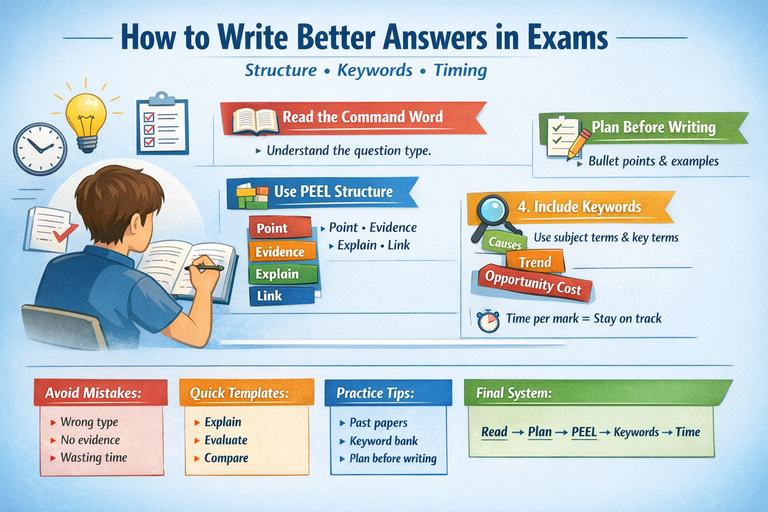
Exam writing tips
One of the best pieces of advice in Exam Writing Tips is to keep out irrelevant content.
Let’s say the question is about unemployment reasons. You don’t need to give a detailed account of the economic evolution of India.
The examiner will see in your writing whether you grasp the question.
You should aim at making sure each paragraph adds something useful to the answer.
Avoid:
- Repetition
- Unrelated facts
- Excessive background information
- Unnecessary quotations
- Very long sentences
Prefer:
- Relevant facts
- Clear arguments
- Examples
- Headings
- Short paragraphs
- Logical flow
5. Use Headings and Subheadings
Headings and subheadings can significantly improve the presentation of your answer.
For example, instead of writing one long paragraph about environmental pollution, you can organise your answer as follows:
Major Causes
- Industrial pollution
- Vehicle emissions
- Deforestation
- Waste generation
Major Impacts
- Health problems
- Biodiversity loss
- Climate change
- Economic losses
Way Forward
- Cleaner technology
- Better waste management
- Public awareness
- Stronger implementation of environmental regulations
This makes the answer visually organised and helps the examiner quickly identify your major points.
6. Use Bullet Points Where Appropriate
The points provided in this article assure you of feedback that is coherent; however, this does not imply that information has to be given only in bullet points. Bullet points might be merged with paragraphs in situations where more thorough explanations are called for.
For instance, in the following bullet list, the advantages of studying online may be indicated:
Some of the advantages of e-studies are:
Availability of various materials
Flexibility
Professional teaching
Recordings of lectures
Promotion of independent studies
This combination of points + explanation often creates a balanced answer.
7. Highlight Important Keywords
Another useful way to craft a good answer is to underline the key words, but not too much, though.
Like, if you are writing about India’s Constitution, you can pick out key terms such as “fundamental rights”, “directive principles”, “judicial review”, “federalism”, and “parliamentary democracy”—and make sure they stand out when it actually matters.
That way the examiner can quickly spot the core ideas inside your response, kind of fast.
However, please don’t go crazy with underlining. If you end up underlining almost every sentence or phrase, then nothing really looks important anymore.
Highlight only the key terms.
8. Use Examples to Strengthen Your Answer
Examples really can make an answer feel more usable and, honestly, more persuasive too.
Like, if you’re responding to a question about how technology plays a role in governance, you might mention a few concrete instances, such as digital public services, online education, digital payments, telemedicine, and e-governance platforms.
These kinds of references sort of show, in a lived context, how the idea actually works, not just in theory. And yeah, it helps because you’re demonstrating real operation, sensibly, instead of staying vague.
Also for competitive examinations, especially those analytical papers, adding fitting examples can turn an average response into something more effective.
Sometimes you need that small shift, from general explanation to clear illustration, and examples do that.
9. Use Facts and Data Carefully
Examples really can make an answer feel more usable and, honestly, more persuasive too.
Like, if you’re responding to a question about how technology plays a role in governance, you might mention a few concrete instances, such as digital public services, online education, digital payments, telemedicine, and e-governance platforms.
These kinds of references sort of show, in a lived context, how the idea actually works, not just in theory. And yeah, it helps because you’re demonstrating real operation, sensibly, instead of staying vague.
Also for competitive examinations, especially those analytical papers, adding fitting examples can turn an average response into something more effective. Sometimes you need that small shift, from general explanation to clear illustration, and examples do that.
10. Improve Your Language
You don’t need some complicated vocabulary to impress the examiner, honestly. In fact, if you use language that’s too difficult, sometimes the answer can turn out less clear, you know. Your main target should be like this: Simple, Precise, and Grammatical Correct Language For English-medium exams, just focus on correct grammar, appropriate vocabulary, clear sentence structure, proper punctuation, and logical paragraphing. For Hindi-medium examinations, use simple, standard, and grammatically correct Hindi. The examiner should understand your point right away, without having to reread a sentence again and again.
11. Improve Your Writing Speed
Time management is among the most significant issues in examinations.
The student can know the correct answer to the question but not have enough time left to write it down due to spending too much time on other questions.
That is why writing speed should be improved through practice.
It is not recommended to suddenly start writing at a very high speed. It is better to practise continuously.
For instance:
Week 1 – Clarity and handwriting
Week 2 – Reduction of unnecessary words
Week 3 – Answer writing in a limited amount of time
Week 4 – Completion of the section under the examination conditions.
The objective is to develop a balance between speed, accuracy and presentation.
12. Practise Answer Writing Every Day
Reading alone cannot make you a good answer writer.
You need to write.
Even 20–30 minutes of daily answer-writing practice can be useful.
You can choose one question from your syllabus every day.
Daily Practice Method
Step 1: Read the question carefully.
Step 2: Spend a minute identifying the demand of the question.
Step 3: Write 3–5 key points before starting.
Step 4: Write the answer within a fixed time.
Step 5: Review your answer.
Step 6: Identify two or three areas for improvement.
This process gradually improves your writing style.
13. Analyse Previous Year’s Question Papers
Previous Year Questions, or PYQs, are extremely useful for competitive exam preparation.
They help you understand:
- The pattern of questions
- Important topics
- Repeated themes
- Question difficulty
- Expected depth of answers
- The way questions are framed
If you are preparing for UPSC, BPSC, JPSC, SSC, Banking or State PCS examinations, make PYQs an important part of your preparation strategy.
Don’t just solve them.
Write answers to them.
That will help you understand what the actual examination expects from you.
14. Learn From Your Mistakes
After writing an answer, don’t simply put your notebook away.
Review it.
Ask yourself:
- Did I answer the exact question?
- Was my introduction relevant?
- Did I cover all major dimensions?
- Did I provide examples?
- Was my conclusion effective?
- Did I repeat any points?
- Did I spend too much time?
- Was my handwriting readable?
Maintain a small answer-writing improvement notebook where you record recurring mistakes.
For example:
My Common Mistakes
- Introduction too long
- Weak conclusions
- Repetition of arguments
- Poor time management
- Not using examples
- Missing important keywords
Review this list every week.
15. Develop a Strong Conclusion
A conclusion is an important part of an essay which gives your response an air of completeness.
Never come to a sudden end once you have made the last statement.
According to the nature of the question, your conclusion can be:
Solution
Balanced view
Future-oriented perspective
Constitutional value
Recommendation
Positive outlook
For instance:
“Sustainable development requires a balance between economic development, environmental protection and social inclusion. A well-coordinated strategy will make it possible to develop successfully.”
The conclusion has to be concise and meaningful. Common Mistakes Students Should Avoid
Even well-prepared students can lose marks because of poor presentation and writing habits.
Avoid these common mistakes:
1. Writing Without Understanding the Question
Always identify what the question demands.
2. Writing Everything You Know
An answer is not a dumping ground for information. Write only what is relevant.
3. Excessive Repetition
Repeating the same argument in different words does not add value.
4. Very Long Introductions
Reach the main topic quickly.
5. No Structure
A continuous block of text can make an answer difficult to evaluate.
6. Poor Time Management
Do not spend too much time on one question.
7. Using Unverified Facts
Incorrect information can weaken your credibility.
8. Ignoring Presentation
Unreadable handwriting, excessive cutting and poor spacing can make an answer difficult to evaluate.
How to Improve Answer Writing in 30 Days
If you want to seriously improve your competitive exam writing skills, try this simple 30-day approach.
Days 1–7: Focus on Structure
Practise writing introductions, main points and conclusions.
Days 8–14: Focus on Content
Add examples, facts, concepts and multiple dimensions to your answers.
Days 15–21: Focus on Speed
Start writing answers under strict time limits.
Days 22–30: Full Practice
Write complete sets of questions under examination conditions.
At the end of each week, review your performance.
The goal is not perfection on Day 1. The goal is continuous improvement.
A Simple Answer Writing Formula
You can remember this formula:
Understand → Think → Structure → Write → Review
Understand
Read the question carefully.
Think
Identify the major points you want to include.
Structure
Decide your introduction, main body and conclusion.
Write
Present your ideas clearly and logically.
Review
Check your answer for relevance, accuracy and presentation.
Following this process regularly can make answer writing much more natural.
Final Thoughts
Examination success is dependent on various aspects such as knowledge, revision, practice, time management, accuracy, and presentation.
Answer writing is one of the skills that you can build.
You need not change your writing style completely. Begin from the scratch. Try writing one answer every day. Analyse your mistakes. Study the previous years’ questions. Practice with time constraints. Improve your presentation gradually.
Most importantly, understand that good answer writing does not necessarily mean that you use difficult words or write lengthy answers. Good answer writing involves presenting your knowledge effectively.
Whatever competitive examination you are appearing for, like UPSC, BPSC, JPSC, SSC, banking, railway, State PCS or any other competitive examination, regular writing practice will be beneficial for you.
So, begin now.
Read more actively, think more critically and write regularly.
For the reason that in a competitive examination, it is not only about knowing the answer but also presenting it.


