


Artificial Intelligence and Jobs: Beyond the Panic, Toward a New Partnership
AI and Jobs in America: Will AI Take Your Job or Create New Opportunities?
AI and jobs in America are changing rapidly.
Artificial intelligence and jobs are transforming the workforce. Discover jobs at risk, future skills, AI careers, and how workers can adapt by 2030.
From writing emails to analysing documents to creating images, artificial intelligence and jobs are now everywhere, helping us answer questions, write code and make business decisions. So what are its next challenges? Artificial intelligence may have come out of the world of science fiction and into our kitchens, but few know as much about its future as those working at the cutting edge.
“Will AI take our jobs?”
It’s an understandable question that has been on many minds. The short answer? Yes — to some extent and in some industries — but much depends on your perspective.
Certainly, there are jobs and tasks where automation seems inevitable. But there are also plenty of opportunities being created by this technology. In addition to driving growth, AI is helping companies become more productive, which means there will continue to be demand for skilled employees with specific sets of talents. What we’re seeing instead of mass unemployment is a significant transformation of the way Americans work.
Rather than see artificial intelligence (AI) as a machine that supersedes human action, perhaps we should consider how this technology shifts the dynamic between people and machines.
AI and Jobs in America: What Is Really Happening?
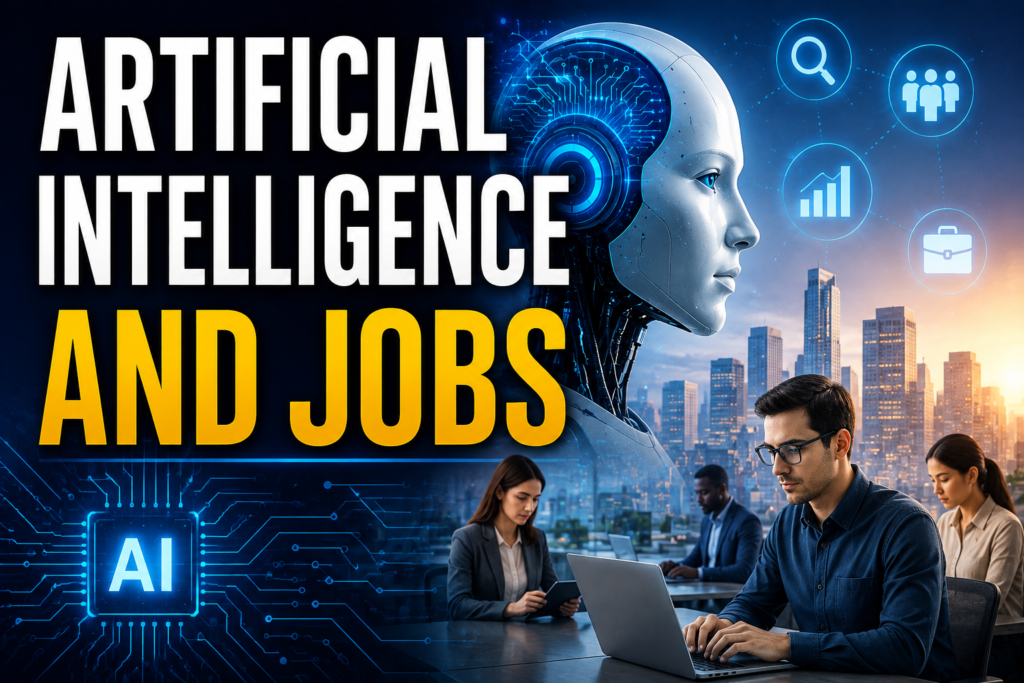
While fears about artificial intelligence are natural – every time companies announce their AI investments, one can’t help but wonder if those investments will result in fewer employees for them to employ – the data doesn’t indicate that we’re seeing an AI employment collapse in America just yet.
So far, this trend has proved that the US’ labour market has been particularly resilient. While we’re seeing increased AI adoption, most businesses have tended towards automating individual tasks (a marketing employee may utilise an AI tool to write their initial article draft), for instance, over whole jobs (a software developer using an AI ‘coding assistant’ tool to produce some basic code).
Other examples could be an accountant utilising an AI tool to organise financial data. Regardless of these changes, an employee is always going to remain.
Here’s where this makes a big difference – the employee will have the potential to accomplish more in less time.
This difference is extremely important when considering what lies ahead for our workforce.
AI Is More Likely to Change Jobs Than Immediately Eliminate Them
If we’re going to imagine how life would be in our AI-free world — and then see just how much more efficient modern tech actually makes things for us — let’s put ourselves back into the past. How did that hypothetical customer-service rep spend their day ten years ago?
Maybe they spent quite a bit of their time responding to enquiries like, “What are your business hours?” Or “Where is my order?” Or “How can I reset my password?” Or “What’s your return policy?”
An AI-powered chatbot could take care of all those queries today. Does this mean there will never be humans working in customer service again?
In other words, definitely not. Instead, I imagine employees spending their time dealing with the complex areas of complaint resolution, dealing with the unusual scenarios, and making people feel heard by engaging them in empathetic negotiations.
This is really just an emerging model of how the human/AI workforce will be interacting with each other. But now machines can take care of more of the repetitive stuff… This means it’s up to us, humans, to focus even more on those things where we excel – namely, our ability to judge, build relationships with others, be creative and take responsibility.
We also need to understand that there may not be equal benefits for all arising from such changes (which are going to pose some significant challenges).
The New Divide: Who Benefits From AI?
The effects of AI on people will probably be unevenly felt.
While some workers may enjoy greatly increased productivity as a result of the introduction of AI, others may realise that their jobs are getting automated.
This creates what one may describe as the K-shaped transformation of the labour market in the US.
In one sense of the word, some groups of people move up due to increased productivity and earnings.
Others are under pressure from the increased unproductivity of their current skills.
1. Repetitive Tasks Are Getting More Susceptible to AI
It turns out that AI works really well with repetitive, predictable and rule-based tasks.
These can include such tasks as:
data entry,
administrative work,
routine content creation,
simple coding,
document processing,
basic research,
scheduling,
customer support,
standardized analysis
The key thing about the presence of AI is that it does not necessarily kill a job.
Rather, it changes it so that what used to take eight hours of a person’s time now only takes two hours because all the routine is done by the system, and now the worker is able to spend six hours doing something else.
2. Entry-Level Positions Can Become Problematic for Young Workers
Probably one of the things that worry the most about AI is its effects on entry-level jobs.
Traditionally, young people gained experience in professions by doing simple tasks.
So a young person would start with simple assignments and, in a couple of years, learn enough about an organisation to become a senior member of a profession.
However, if there is AI that can do many of these simple tasks, there is a danger of creating a problem.
If an organisation doesn’t need as many people to perform routine entry-level tasks anymore, young people will get fewer opportunities to gain the experience they need to become senior members of their professions.
3. AI Can Make Senior Professionals Even More Valuable
The situation with older workers can turn out to be quite different.
Let’s say an experienced lawyer uses AI to review thousands of pages of documents.
It can easily find patterns and sum things up.
But then somebody needs to ask such questions as the following:
What is truly important?
This is where professional judgement is needed.
And the same is true about doctors, engineers, managers, teachers, consultants, financial professionals and many other occupations.
An experienced professional can become much more productive
The Biggest Economic Question: Who Gets the Benefits?
There is still one more topic that should be mentioned.
AI increases productivity.
But higher productivity does not mean that salaries will rise for each individual employee.
For instance, a company uses AI and discovers that now ten people are able to perform the job that used to require fifteen workers.
And then the company either cuts its workforce or raises its productivity.
The problem is:
Who will reap the economic rewards?
These rewards can be reaped by companies or investors in the form of profits or productivity.
Customers can benefit from the lower prices of the products.
Employees can also profit from AI if it raises productivity and employees’ wages.
But employees can also lose their bargaining position because companies will be able to produce the same results with fewer people.
So the allocation of economic rewards from AI is the key challenge of the decade ahead.
AI Is Creating Jobs Too
It is very easy to zero in on jobs that might be endangered by AI.
Technological upheavals can, however, bring about whole new industries and professions.
There is already a growing demand for specialists in the fields of
Artificial intelligence
Machine learning
Data analysis
AI governance
Cybersecurity
AI safety
Automation
Cloud computing
Prompt design
Technology management
AI auditing
Some of these professions did not even exist a decade ago.
There is, however, one serious issue.
Those workers who lost traditional jobs will not necessarily have the skills required for new professions.
There will be a skills gap.
Consider a person who worked for fifteen years in an office job.
A firm may need an AI systems specialist.
Saying to such a worker, “Learn AI”, will not suffice.
Learning requires time.
Education requires money.
And one needs to pay a mortgage, raise children, etc.
That is why reskilling will be one of the major economic problems of the age of AI.
AI Anxiety Is Real
In addition to unemployment, the mere possibility of this situation has a negative effect on the lives of many people.
American people are afraid that AI will play a role as a factor that puts their jobs, as well as those of their relatives, in danger.
However, it is not surprising at all that American people are afraid because their fears are quite reasonable.
They observe the process of introduction of new technologies, which results in the development of digital production and the appearance of software that decreases the necessity to employ certain specialists.
AI is one of the elements of this technological development, which proceeds faster than before.
One should pay attention to the psychological aspect of the issue.
Will they be able to apply their knowledge and skills in five or ten years?
What kind of career perspectives will exist for their children?
Will this technological development be good for them or only for the companies?
This is not the problem of the technologies.
It is a problem of people.
The Companies That Use AI Well May Look Different
Not all firms will adopt AI similarly.
One such adoption strategy would be adopting AI as a mechanism of cutting costs.
The strategy itself is quite simple:
To achieve the same level of production through fewer staff.
A second strategy would be adopting AI as a growth strategy.
Without immediately laying off their employees, companies can leverage AI to increase the productivity of their workforce.
For example, using AI to examine the behaviour of customers for a sales force that determines who the prospects are.
Leveraging AI to quickly test ideas for a marketing force, accelerate product development for an engineering force or even answer customer enquiries for a customer service force.
In other words, there is a symbiotic relationship between the human workforce and the adoption of AI technologies.
Firms that have invested in the training of their workforce will definitely benefit more from this strategy.
What Jobs Are Safer From AI?
There is not a single job that would completely avoid technological influence.
However, there are certain kinds of jobs that will depend largely on unique human qualities.
They will involve:
Complex Decision Making
Artificial intelligence can make suggestions, but the human element will most often be required to make tough decisions.
Managers, executives, doctors, engineers and other specialists work in conditions where there is no right choice.
Human Connections
Empathy cannot be replaced by an automated process.
Careers associated with negotiation, counselling, leadership, education, caregiving and building relationships may be highly dependent on human interaction.
Creativity and Originality
AI can suggest various ideas, but the human factor will decide what ideas make sense and can be used.
Creative professionals who know how to use AI technology as an additional resource may become even more efficient.
Physical and Real-World Skills
Some professions require people to do their work in an ever-changing physical world.
Electricians, plumbers, builders, mechanics and other specialists will have to deal with unpredictable circumstances.
Robots will one day replace people in these industries, but full-scale automation may prove to be more difficult than automating an online procedure.
The Most Important Skill May Be Adaptability
For ages, it has been stressed to people that they should acquire knowledge to become an expert in their chosen field in business.
But with the advent of AI, this practice may soon become irrelevant.
The skills that are required today may become obsolete in the coming days due to AI.
Thus, the only thing that people need to know is to learn.
Those employees who are aware of various things would always be ready to handle any advancement in technology.
This may involve learning about AI or improving their communication, leadership skills, or even data analysis skills.
They don’t have to become an expert in every new AI tool that comes up.
Instead, they have to learn how to learn.
What Should American Workers Do?
In case you worry about how the emergence of AI technology will affect your professional life, panic will not do any good for you.
Preparation would be more appropriate.
First of all, you should find out which of the tasks related to your profession are repetitive.
These are the questions you should ask yourself:
Can these repetitive tasks be done with the help of AI?
If you think that the answer is positive, you will have to stop competing against AI and start learning how to use AI.
So, the reporter can learn how to use AI for the purposes of data analysis.
The writer can learn how to research and edit texts with the help of AI.
The sales manager can learn how to analyse the client base using AI.
The office manager can learn workflow automation.
The goal here would be to move from the performer of repetitive tasks to the controller and analyst of processes.
What Does the Future of Work Look Like in 2030?
The exact number of jobs that will be substituted due to the implementation of AI technology till 2030 cannot be estimated now.
The adoption of technologies depends on the costs of the process, regulations, customers’ preferences, the economy and the willingness of companies to change the way of their functioning.
Nevertheless, it is obvious:
The labour market of 2030 will not be the same as it is nowadays.
There will be occupations whose number will decrease.
There will be professions which will be in demand.
There will be occupations that will change so much that they will be almost new, but will still exist.
One can get an occupation which does not even exist nowadays by 2030.
Moreover, people will work in cooperation with artificial intelligence technologies.
The future labour market is going to be cooperation between artificial and human intelligence.
Education Must Change Too
The problem cannot be addressed through workers alone.
Schools, colleges, and training institutions will also have to adapt.
Whereas the skills needed by employers have been transformed by AI technology, the education sector must also transform itself.
Students will not only be required to know the technical aspects but will also have to learn the following:
Critical thinking
Communication
Problem-solving
Creativity
Collaboration
Digital literacy
AI literacy
Adaptability
Memory for information might become unimportant when AI is able to get information immediately.
Evaluation of information could become more important.
This is a fundamental shift in education.
AI Will Not Simply Replace Humans—It Will Redefine Work
The fundamental error may be in viewing the issue of AI in the context of a basic conflict:
Human against machine.
The more fascinating alternative is:
Human + machine.
A physician equipped with artificial intelligence technology can analyse data more quickly.
A teacher using AI can customise education.
An engineer can conduct more tests.
A journalist can search for information better.
A small business person can get access to resources which would previously require an entire team.
In all these cases, AI need not render the contribution of humans unnecessary.
It could actually enhance their value.
However, such a scenario is not assured.
It will depend on the response of businesses, government, educators and workers.
Conclusion: The Future Is a Partnership
There are two possibilities associated with the relationship between the development of artificial intelligence and work in America.
One of them is the issue of job loss due to automation.
Another one is the utopian future of growing productivity and the benefit of everybody.
In reality, the actual state of affairs should fall somewhere in the middle.
AI will cause jobs to disappear.
AI will change the nature of many jobs.
AI will generate new jobs.
AI will raise productivity.
And AI will support people who are adaptive and eager to learn.
The real challenge will not be the prevention of the disappearance of jobs due to artificial intelligence.
It will be in ensuring enough educational opportunities for people to join the new economy.
The future work cannot be about people’s attempts to beat machines in their strong sides.
It has to be about using machines to perform the tasks that people are good at.
Among these tasks are judgement, creativity, leadership, empathy, curiosity, problem-solving and decision-making in a complex environment.
Artificial intelligence could transform the American workplace completely by 2030. Yet, the key question will not be whether machines will work.
They do.
The essential question will be whether Americans are ready to work with machines.
Table of Contents
- Artificial Intelligence and Jobs: What Is Changing?
- How AI Is Transforming the American Workforce
- Which Jobs Are Most Vulnerable to AI?
- Jobs AI Is Most Likely to Change, Not Replace
- Jobs That May Grow Because of AI
- The Rise of AI Skills in the Workplace
- What Skills Will Matter by 2030?
- How Workers Can Adapt to AI
- AI and Entry-Level Jobs
- Will AI Cause Mass Unemployment?
- AI and Human-AI Collaboration
- The Future of Artificial Intelligence and Jobs
- Frequently Asked Questions
- Conclusion
Primary Keyword: AI and jobs in America
Secondary Keywords:
AI jobs in America, artificial intelligence and employment, future of jobs in USA, AI replacing jobs, AI job market 2030, jobs affected by AI, future of work in America, AI and employment trends, artificial intelligence jobs, AI workforce transformation
Suggested Tags
#AIandJobs #ArtificialIntelligence #FutureOfWork #AIJobs #JobsInAmerica #USJobs #Employment #FutureOfJobs #AIRevolution #AmericanWorkforce #Technology #WorkplaceAI #AI2030 #CareerTrends
artificial intelligence and jobs


