


Colombia earthquake, Colombia earthquake news, Cali earthquake, Colombia earthquake latest news, 7.4 magnitude earthquake, earthquake in Colombia 2026, Cali earthquake deaths, Colombia earthquake death toll, western Colombia earthquake, earthquake live updates
Colombia Earthquake News Live Updates: Death Toll Hits 164 as 7.4-Magnitude Quake Devastates Western Colombia.
Colombia earthquake latest news: A powerful 7.4-magnitude earthquake has killed at least 164 people, including 85 in Cali. Rescue teams continue searching for survivors in collapsed buildings across western Colombia.
Colombia Earthquake Latest News, August 11, 2026: A powerful 7.4-magnitude earthquake has devastated western Colombia, leaving at least 164 people dead and hundreds injured as rescue teams continue searching through collapsed buildings for survivors.
The earthquake struck on Monday, August 10, shaking Colombia’s coffee-growing heartland and causing widespread destruction in cities including Cali, Pereira, Quibdó and Manizales. Rescue operations continued into Tuesday as emergency workers, soldiers, police officers and ordinary residents searched through mountains of concrete and twisted metal.
Death Toll Rises as Search Operations Continue
According to the latest Reuters report, at least 164 people have died in the Colombia Earthquake Latest News, August 11, 2026: disaster. Cali has emerged as one of the worst-hit cities, with at least 85 deaths reported.
Pereira has also suffered severe losses, with authorities reporting dozens of fatalities. Another 13 deaths were reported in Chocó, the rural region closest to the earthquake’s epicenter. Officials warn that the death toll could increase as rescuers reach areas that remain difficult to access.
For families waiting outside damaged buildings, however, the numbers tell only part of the story.
Behind every missing-person report is a family waiting for a phone call. Behind every collapsed home is a person wondering whether they will ever be able to return.
Cali: Hospitals Damaged, Patients Treated on the Streets
Cali, a city of approximately 2.2 million people, experienced some of the most devastating destruction.
Several upper floors of a hospital, including areas used for paediatric care, collapsed during the earthquake. According to the hospital director, around 600 patients had to be cared for outside on a rubble-covered street after the building was damaged.
Residents were forced into the streets, many carrying only what they could grab in the first few moments after the shaking began.
One of the most emotional parts of the rescue effort has been the involvement of ordinary citizens. Reuters reported that volunteer Carmen Yasmin Garcia and her group helped rescue seven people from a collapsed building, while others remained trapped.
This is the human side of the disaster: strangers digging beside emergency workers, families searching for loved ones and volunteers refusing to walk away while there is still hope.
What Happened in Colombia?
The earthquake struck early Monday in western Colombia. The epicentre was near San José del Palmar in the Chocó region, approximately 400 kilometres west of Bogotá.
The United States Geological Survey identified the epicentre in the remote Chocó region. The earthquake was felt across a wide area, including neighbouring Ecuador and Panama.
Colombia’s Geological Service described the earthquake as the strongest recorded in the country during the 21st century. Several aftershocks followed the main earthquake, adding to the fear of residents and complicating rescue operations.
More Than 1,600 Buildings Damaged
The scale of destruction is enormous.
Initial reports indicated that around 1,600 buildings were damaged, with at least 61 buildings completely collapsed. Roads, homes, commercial buildings and other infrastructure were affected across western Colombia.
In Manizales, a tower of the city’s historic neo-Gothic cathedral collapsed onto the nave.
In Pereira, buildings and residential blocks were reduced to piles of concrete and twisted steel. At the airport, parts of the ceiling reportedly collapsed while frightened passengers tried to find safety.
Rescue Workers Race Against Time
The second day after a major earthquake can be crucial for people trapped beneath rubble.
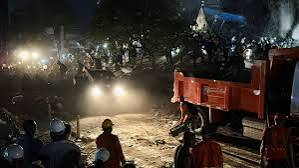
Emergency teams in Colombia have been working through the night with excavators and heavy equipment. In some locations, rescuers have used their bare hands when machinery could not safely reach the debris.
The search is especially challenging in Chocó, one of Colombia’s most remote regions. Dense jungle, damaged infrastructure and communication problems are making it difficult for authorities to determine the full scale of the disaster.
Every sound coming from beneath the rubble can bring a moment of hope.
For rescuers, the mission is simple: find the living before it is too late.
Government Declares Emergency
President Abelardo de la Espriella, who had taken office only days before the earthquake, declared an emergency to accelerate the government’s response and release resources for recovery.
Security forces were also sent to affected areas after reports of looting in Cali. Curfews were imposed in Cali and Pereira as authorities attempted to maintain order while rescue and relief operations continued.
The disaster represents one of the first major tests for Colombia’s new government.
International Support Begins Arriving
Colombia is not facing the disaster alone.
The United States announced $15.5 million in emergency assistance for shelter, food and earthquake-response efforts. Other countries in Latin America, including El Salvador, Mexico and Chile, also offered assistance, including rescue teams, medical personnel and emergency supplies.
International support could become increasingly important as Colombia moves from immediate rescue operations toward medical care, temporary shelter and reconstruction.
Why Colombia Is Vulnerable to Earthquakes
Western Colombia lies in a highly active seismic region associated with the Pacific Ring of Fire. Earthquakes are not unusual in the country, although earthquakes above magnitude 6 are relatively rare.
The latest earthquake is being compared with the devastating 1999 Armenia earthquake, which killed more than 1,100 people.
The current disaster is therefore more than a single terrifying morning. It is another reminder that earthquake preparedness can mean the difference between life and death.
The Human Story Behind the Numbers
News reports often reduce disasters to statistics: 164 dead, hundreds injured, 1,600 buildings damaged.
But those numbers represent real lives.
A father who may not return home tonight.
A mother searching through a list of missing people.
A child being treated outside a damaged hospital.
A rescue worker who has spent hours digging through concrete.
And a volunteer who keeps searching because someone might still be alive underneath.
In Cali and Pereira, thousands of people are now facing an uncertain night. Some have lost their homes. Others are still waiting for news about relatives and friends.
Yet amid the destruction, there are also extraordinary stories of courage and solidarity.
What Happens Next?
The immediate priority remains search and rescue. Authorities must locate survivors, provide emergency medical treatment, establish temporary shelters and assess damaged infrastructure.
The full death toll is likely to become clearer only after rescue teams reach the hardest-hit and most remote areas.
For now, Colombia is holding its breath.
The rubble is still being searched.
The missing are still being counted.
And rescuers are still listening for signs of life.
Colombia Earthquake: Key Facts
- Magnitude: 7.4
- Date: August 10, 2026
- Epicenter: Near San José del Palmar, Chocó
- Latest reported deaths: At least 164
- Deaths reported in Cali: At least 85
- Buildings damaged: Around 1,600
- Completely collapsed buildings: At least 61
- Majorly affected areas: Cali, Pereira, Quibdó, Manizales and surrounding regions
- Rescue operations: Ongoing
- International assistance: Offered by the United States and several Latin American countries
Important: Casualty and damage figures remain provisional and may change as rescue teams continue their work. This article reflects reports available on August 11, 2026.


