


AI vs. Human Intelligence: Can AI Replace Humans?
Explore AI vs human intelligence and discover whether artificial intelligence can truly replace humans. Learn the key differences, strengths, limitations, real-world applications, and what the future holds for AI and human collaboration.
The Rise of the Algorithmic Age
To understand where we are going, we must first look at how we arrived here. For decades, computers were merely calculators—glorified digital ledger books that could only execute explicit code. The paradigm shift occurred with the advent of machine learning, a subset of AI that allows software to learn from historical data patterns without direct human programming.
Today, this capability powers everything from advanced predictive systems in corporate boardrooms to the virtual assistants residing in our smartphones. The sheer computational capacity of modern hardware means that machines can parse terabytes of information in a fraction of a second. This rapid evolution highlights the growing importance of artificial intelligence as a foundational pillar of modern infrastructure, driving efficiencies that were physically impossible just a decade ago.
Yet, despite these staggering technical leaps, a critical question lingers: does data processing equate to true understanding?
Mechanical Efficiency vs. Conscious Intuition
To compare human intelligence with artificial intelligence, we must analyze how each gathers and processes information.
       [Raw Data & Inputs]
               │
       ┌───────┴───────┐
       ▼               ▼
┌─────────────┐ ┌─────────────┐
│   Human     │ │ Artificial  │
│ Intelligence│ │ Intelligence│
└──────┬──────┘ └──────┬──────┘
       │               │
  (Intuition,     (Algorithms,
   Empathy &       Data & Pure
  Contextual      Statistical
   Judgment)       Patterns)
       │               │
       └───────┬───────┘
               ▼
      [Strategic Actions]
Human intelligence is inherently biological, rooted in billions of neurons firing across synapses, shaped by millions of years of evolutionary survival. It relies heavily on intuition, contextual awareness, emotional nuance, and the unique ability to learn from a single, isolated experience. A human child does not need to see ten thousand pictures of a cat to identify one; they see it once, touch its fur, hear it purr, and the concept is forever mapped into their consciousness.
Conversely, artificial intelligence relies completely on mathematics, statistical probability, and structured input. An AI does not “know” what a cat is in the emotional or physical sense. It merely recognizes pixel distributions and statistical correlations that match its training dataset. While this makes the machine incredibly precise at specific tasks, it leaves it entirely rigid when forced outside its narrow domain.
How AI Helps in Daily Life: The Invisible Subsumption

You do not have to look far to see this technology in action. In fact, observing how AI helps in daily life reveals just how deeply integrated these algorithms have quietly become.
Consider the seamless routine of a modern morning. Your smartphone unlocks using facial recognition algorithms. Your email inbox automatically filters out malicious spam while drafting quick, context-aware replies. When you commute, navigation apps analyze real-time transit data to redirect you away from traffic bottlenecks. These are not futuristic anomalies; they are everyday examples of automation working quietly behind the scenes to optimize our schedules.
The Evolution of Smart Devices
The physical spaces we inhabit have transformed as well. The proliferation of smart devices—from thermostats that learn your temperature preferences to refrigerators that track nutritional inventory—has altered consumer habits. These tools rely heavily on continuous data analysis to function optimally. By monitoring user behavior, they actively adapt to save energy, streamline chores, and enhance personal productivity.
Industry Transformation: Healthcare and Education
Beyond individual conveniences, the societal importance of artificial intelligence becomes explicitly clear when observing its transformative impact on essential public sectors.
AI in Healthcare
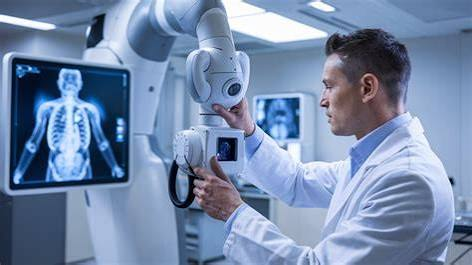
In medicine, algorithms are rapidly shifting from administrative tools to active diagnostic assistants. By utilizing deep learning models, AI in healthcare can scan medical imagery—such as X-rays, MRIs, and CT scans—to identify anomalous cellular growths with a degree of statistical accuracy that rivals top radiologists.
Furthermore, the technology is radically compressing the timelines required for drug discovery. What used to take human researchers years of manual laboratory trial and error can now be modeled virtually in a matter of days, allowing life-saving therapeutics to reach clinical trials at unprecedented speeds.
AI in Education
Similarly, the classroom framework is undergoing a major structural revision. The integration of AI in education allows for the creation of hyper-personalized learning pathways. Traditional educational models have long suffered from a “one-size-fits-all” limitation, where a single teacher must accommodate dozens of students with widely varying learning speeds.
AI-driven platforms can analyze a student’s performance in real time, identifying specific conceptual gaps and dynamically adjusting the curriculum’s difficulty. This ensures that advanced learners remain constantly challenged while struggling students receive the targeted remedial exercises they need to catch up.
The Human Advantage: What Silicon Cannot Replicate
With software managing medical diagnostics and educational pathways, it is easy to succumb to the fear of human obsolescence. However, an objective analysis reveals that the core elements of human capability remain fundamentally beyond the reach of silicon lines of code.
1. True Creative Innovation
An AI can write a sonnet in the style of Shakespeare or generate a painting reminiscent of Rembrandt. However, it is vital to remember that the machine is not truly creating; it is interpolating. It shuffles existing human datasets to generate a statistically plausible output.
True human creativity is born from subversion, emotional trauma, joy, and structural accidents. A machine cannot experience a heartbreak, look at a sunset with existential longing, or intentionally break a rule of art to forge an entirely new movement.
2. Emotional Intelligence and Empathy
While a chatbot can be programmed to use comforting words, it possesses no internal emotional landscape. It does not feel empathy, grief, or camaraderie. In fields that require deep human trust—such as psychological therapy, complex corporate negotiations, and community leadership—the human element is not just preferred; it is structurally mandatory.
3. Ethical Judgment and Accountability
When a human leader makes a critical decision, they bear the ethical weight of the consequences. An algorithm operates entirely outside the realm of morality. It executes functions based strictly on optimization metrics. If an automated driving system makes an error, the machine feels no remorse, nor can it be held legally accountable in a court of law. The necessity of human oversight remains absolute wherever ethics are concerned.
Navigating the Challenges of AI Ethics
As we rely more heavily on algorithmic decisions, the discourse surrounding AI ethics has transformed from an academic debate into a pressing legal and social priority. Algorithms are trained on historical data created by humans, meaning they naturally inherit the systemic biases, prejudices, and historical inequities embedded within that data.
If a machine learning model is trained on historical corporate hiring data that systematically favored one demographic over another, the AI will learn to reject qualified candidates from underrepresented backgrounds under the guise of objective optimization. Left unchecked, automation can rapidly scale bias, institutionalizing discrimination at an unprecedented rate. Resolving these deep structural flaws requires human critical thinking, cultural awareness, and constant regulatory intervention.
The Future of AI Technology: Centaurs, Not Replacements
As we look toward the horizon, the future of AI technology will not be defined by a dystopian war for supremacy between man and machine. Instead, we are entering an era characterized by deep, systemic collaboration.
┌─────────────────────────┐      ┌─────────────────────────┐
│   Human Intelligence    │      │ Artificial Intelligence │
├─────────────────────────┤      ├─────────────────────────┤
│ • Emotional Depth (EQ)  │      │ • Computational Scale   │
│ • Contextual Judgment   │  ▲   │ • High-Speed Automation │
│ • Ethical Frameworks    │  │   │ • Deep Pattern Analysis │
└────────────┬────────────┘  │   └────────────┬────────────┘
             │               │                │
             │               │                │
             ▼               ▼                ▼
       ┌────────────────────────────────────────────┐
       │         The Collaborative Ideal            │
       │  (Humans directing AI leverage to expand   │
       │   creativity, productivity & discovery)    │
       └────────────────────────────────────────────┘
The future belongs to the “Centaur”—a term borrowed from chess, describing a human player working in perfect tandem with a computer engine. By delegating data analysis, routine cognitive tasks, and systemic tracking to digital tools, human professionals are liberated to operate at the absolute peak of their cognitive potential.
Architects will use algorithms to test structural integrity across thousands of simulated weather patterns in seconds, leaving them free to focus entirely on spatial aesthetics and community integration. Writers will use automated research engines to synthesize complex topics instantly, allowing them to devote their energy to narrative structure and emotional resonance. The focus is rapidly shifting away from tool usage toward systemic problem-solving and strategic curation.
Conclusion: The Symbiotic Horizon
Ultimately, exploring how AI helps in daily life underscores a foundational truth: machines are designed to optimize answers, whereas humans are uniquely engineered to question them. The ongoing expansion of digital infrastructure does not diminish our worth; rather, it highlights the irreplaceable value of our own consciousness, empathy, and creative drive.
As we step decisively into the future of AI technology, our primary objective must not be to build machines that mimic the human soul, but to construct systems that empower it. Understanding the foundational importance of artificial intelligence allows us to shed defensive anxieties and view these tools as cognitive leverage. By letting algorithms manage the routine, we reclaim the space to be profoundly, distinctively human.


